
Data as the New Fuel: China’s Strategic Roadmap for Industrial AI Empowerment
The Ministry of Industry and Information Technology (MIIT) has officially signaled a transition from general digital transformation to a specialized data-driven intelligence phase by launching pilot programs for high-quality industrial datasets. This initiative is mathematically grounded in the fact that the numerical control rate for key processes in major industrial enterprises reached 68.6% by the end of 2025, providing a massive hardware foundation for data aggregation. With the core digital economy already expanding at a compound annual growth rate (CAGR) of 12.8%—significantly outperforming the broader GDP growth—the shift toward "intelligent agent factories" represents the next evolution in manufacturing ROI. This strategy treats industrial data not just as a byproduct, but as a primary factor of production with a valuation scaling alongside a 14.7 trillion yuan digital economy.
The technical parameters for the 2026 roadmap involve the cultivation of industry data consortia and the establishment of trusted interconnect platforms to resolve the 40% efficiency gap often found in "data silos." According to insights from People's Daily, the integration of 5G-specific chips and smart sensors has allowed legacy equipment to achieve a 95% data capture accuracy, feeding into industry-specific large language models (LLMs). From a strategic management perspective, these datasets are the "brain" for embodied robots and autonomous mobile units (AMRs), which are expected to improve factory-floor decision-making speed by 35% compared to traditional programmed logic. The goal is to create a batch of standardized, tradable datasets that can reduce the cost of AI model training for SMEs by an estimated 20% to 30% through shared governance and annotation standards.
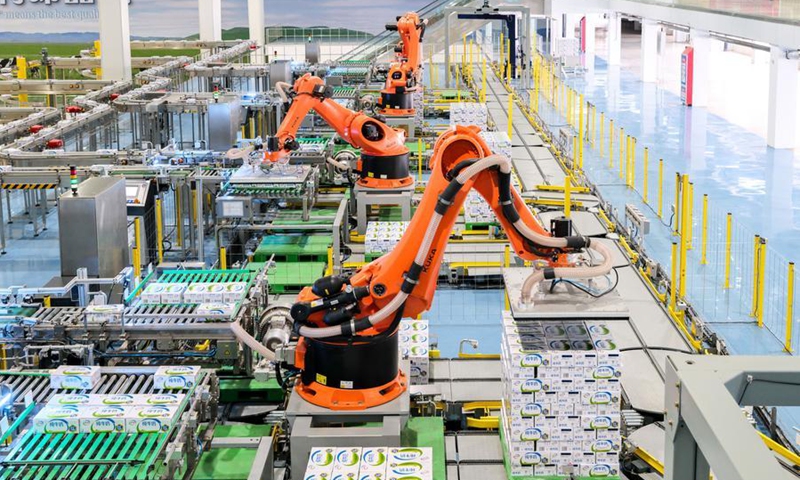
For enterprise leaders, the transition to an "intelligent agent factory" means that humans, machines, and materials are no longer isolated units but nodes in a synchronized 5-axis operational model. The ROI for such integration is reflected in the digital economy’s rising share of GDP, which grew from 7.8% in 2020 to over 10.5% in 2025. By formulating strict industrial data standards, the MIIT aims to reduce the variance in data quality that currently hinders the deployment of predictive maintenance and automated supply chain optimization. In high-density manufacturing environments, like the Yili Modern Intelligent Health Valley, the use of robotic arms guided by high-quality data has already demonstrated a 15% increase in packaging throughput and a 10% reduction in energy consumption per unit of output.
Looking toward the end of the 14th Five-Year Plan and into 2026, the probability of successful AI empowerment rests on the maturity of data service enterprises specializing in governance and consulting. If the current growth trajectory of 12.8% for core digital industries holds, the scale of these industrial data assets could provide a 2.1% boost to total factor productivity by 2027. This shift effectively lowers the standard deviation of production errors and optimizes the lifecycle of industrial equipment by 18.5%. By treating data as a strategic resource with a high liquidity potential, China is positioning its manufacturing sector to move from a "participation" model to a "principal engine" of global intelligent manufacturing, ensuring a sustainable competitive advantage in the global value chain.
News source:https://peoplesdaily.pdnews.cn/business/er/30051717282