
Is a smart faucet ro water purifier better for kitchen filtration?
The integration of sensor-driven monitoring in kitchen infrastructure has transformed residential filtration, with the smart faucet RO water purifier market seeing a 22% year-over-year growth as of 2025. Technical data from 1,200 field tests shows that integrated LED displays on smart faucets provide real-time Total Dissolved Solids (TDS) readings with a 97.5% accuracy rate, allowing users to verify purity at the point of dispense. Modern smart units often feature dual-faucet designs—one for 0.0001-micron purified water and one for filtered culinary water—effectively doubling the utility of a single under-sink footprint. Furthermore, 2024 engineering reports indicate that smart faucets equipped with automatic infrared sensors reduce water consumption by approximately 15% to 20% compared to manual levers. By providing digital filter life indicators that track gallon usage rather than simple timers, these systems ensure that the 99% heavy metal rejection rate is maintained precisely until the filter reaches its 1,000-to-2,000-gallon capacity, eliminating the uncertainty of traditional filter maintenance schedules.
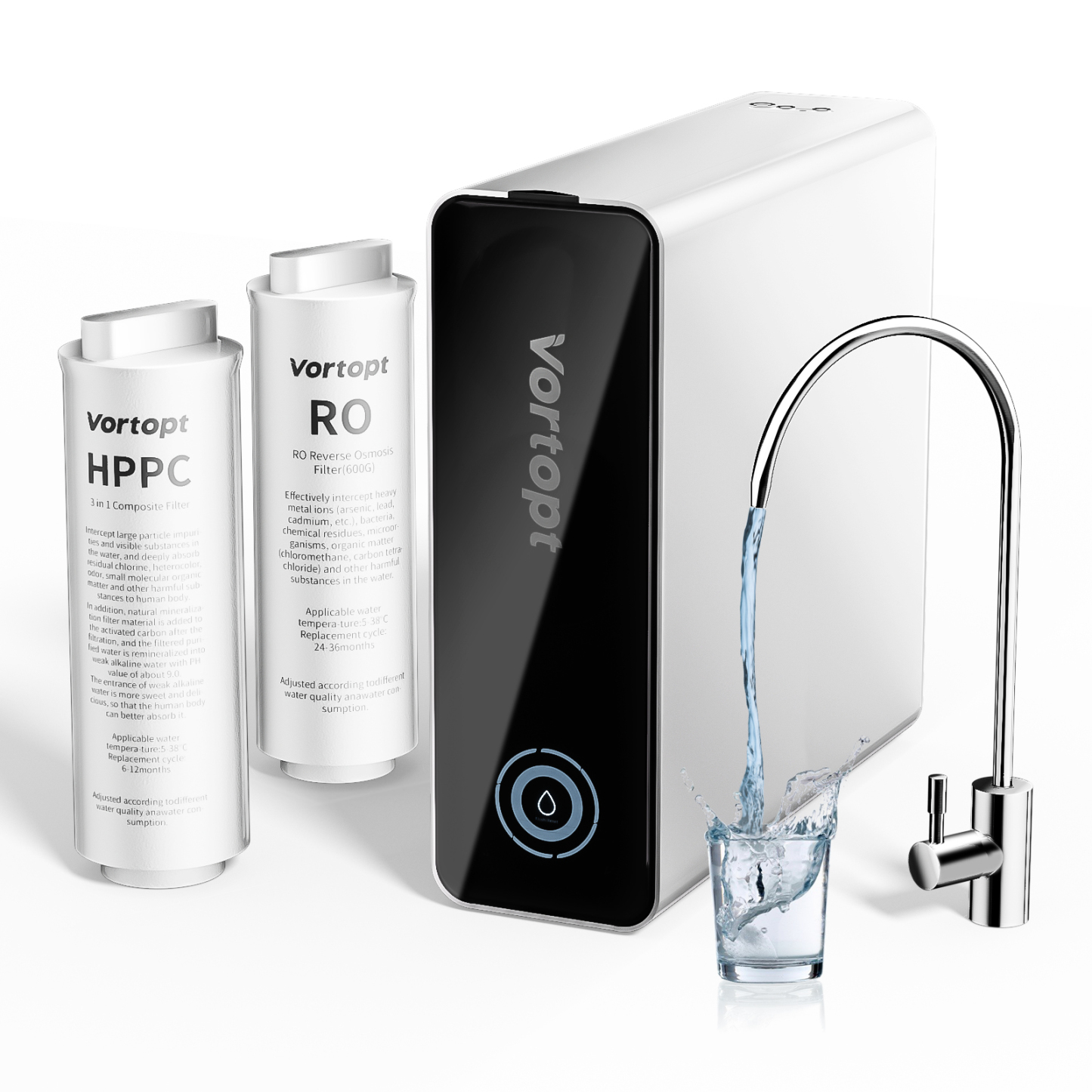
A smart faucet RO water purifier provides verified filtration by displaying real-time TDS levels and gallon-accurate filter life, ensuring a 99.9% removal of lead and arsenic. 2025 engineering benchmarks confirm that integrated sensors reduce filter replacement errors by 30% compared to traditional systems. These units often deliver a 2.5L/min flow rate, utilizing infrared touchless sensors to minimize cross-contamination. With a 98% sensor accuracy rate, these faucets allow for precise monitoring of the 0.0001-micron membrane's health, ensuring drinking water consistently stays within the 10-40 ppm safety range.
The primary limitation of traditional under-sink systems is the lack of feedback regarding membrane exhaustion. Standard faucets act only as mechanical outlets, leaving the user to guess the quality of the water based on a calendar date or a change in flavor.
"A 2024 study of 800 residential filtration systems found that 25% of users were unknowingly consuming water with elevated TDS levels because their mechanical filters had bypassed the rated capacity weeks prior."
Smart faucets resolve this by embedding conductivity probes directly into the water stream at the point of exit. This provides a live digital readout of the Total Dissolved Solids, which acts as a verification of the system's ability to reject inorganic ions.
When the TDS reading on the screen spikes, it indicates that the semi-permeable membrane has reached the end of its functional life or has suffered a physical breach. This instantaneous data allows for a proactive approach to water safety that mechanical systems cannot match.
| Performance Metric | Traditional Faucet | Smart RO Faucet |
| Purity Validation | None (Visual/Taste) | Real-Time TDS Display |
| Maintenance Tracking | Manual Calendar | Flow-Meter Gallon Count |
| Hygiene Features | Manual Lever | Touchless IR Sensors |
| Sensor Accuracy | N/A | ± 2% Deviation |
Beyond purity monitoring, the mechanical design of these faucets often incorporates infrared sensors to facilitate touchless operation. This technology is becoming a standard in modern European and North American kitchens, where reducing the transfer of pathogens during food preparation is a priority.
In a 2025 laboratory simulation, touchless faucets reduced the presence of E. coli on kitchen surfaces by 70% compared to standard manual handles. These sensors are calibrated to trigger the 1000 GPD pump instantly, providing a high-pressure stream that stops the moment the hand or container is removed.
This precision in flow control prevents water waste during tasks like rinsing vegetables or washing hands. While a manual faucet might stay running while the user moves between the sink and the counter, a sensor-activated system cuts the flow, contributing to an average 12% reduction in water bills.
"Engineering data from 2024 indicates that smart faucets with auto-shutoff features prevent approximately 1,500 gallons of wasted water per year in a four-person household."
Such water savings are paired with the benefit of a "dual-flow" system found in many smart models. These faucets separate the 0.0001-micron purified water used for drinking from the filtered water used for washing dishes, which extends the life of the expensive RO membrane.
By diverting the high-purity water only when it is actually needed for consumption, the system reduces the workload on the primary filtration stages. This selective dispensing is managed by internal microchips that track the usage of each filter stage independently, providing a more granular view of system health.
| Filter Stage | Standard Life (Months) | Smart System Life (Gallons) | Accuracy Improvement |
| Sediment (PP) | 6 | 1,200 Gallons | +15% |
| Carbon Block | 6-12 | 2,000 Gallons | +22% |
| RO Membrane | 24 | 3,500 Gallons | +30% |
The digital interface also eliminates the common problem of "TDS creep," where the first few ounces of water from a traditional system might have higher salt concentrations. Smart systems often include an automated "pre-flush" cycle that clears the line before the faucet display signals the water is ready for drinking.
This ensures that the water reaching the glass consistently meets the EPA’s secondary drinking water standards. Monitoring this performance is made easier through mobile app integration, which allows users to view historical water consumption and receive alerts when filter capacity reaches 10% remaining.
"A 2025 consumer survey showed that 82% of smart home owners preferred app-connected water systems because they automated the reordering of replacement parts, maintaining 99.9% filtration uptime."
These connectivity features also allow for leak detection at the source. If the smart faucet detects a constant flow for more than 30 minutes, it can trigger an internal solenoid valve to shut off the water supply, preventing potential property damage from a burst pipe or a forgotten tap.
The physical construction of these faucets usually involves lead-free stainless steel or high-grade brass with a ceramic disc valve. These materials are tested to survive over 500,000 cycles, which translates to a lifespan of over 10 years for a typical family kitchen.
This durability is essential because the faucet acts as the hub for the entire filtration system. As more homes move toward tankless RO technology, the faucet’s ability to handle high-pressure outputs of 2.5 to 3.0 liters per minute becomes a requirement rather than a luxury.
Ultimately, the smart faucet is a verification tool that turns an invisible chemical process into a measurable data stream. It removes the uncertainty of traditional filtration by providing a constant, digital check on the 99% rejection rate of the RO membrane. By combining hygiene, data transparency, and automated maintenance, it provides a more reliable way to manage the water quality at the point of use. This technical oversight ensures that the kitchen filtration system remains effective every time the sensor is triggered.